Friday night I had an idea. Sunday night extraction.work was live. 1,189 crypto incidents catalogued, $115 billion total, deployed on its own domain. No spec, no PM, no roadmap. Vibe-coded with Claude Code. The toy poodle reviewed the architecture from the next chair.
This is what shipped, what surprised me, and what I'd do differently.
What it is, in 60 seconds
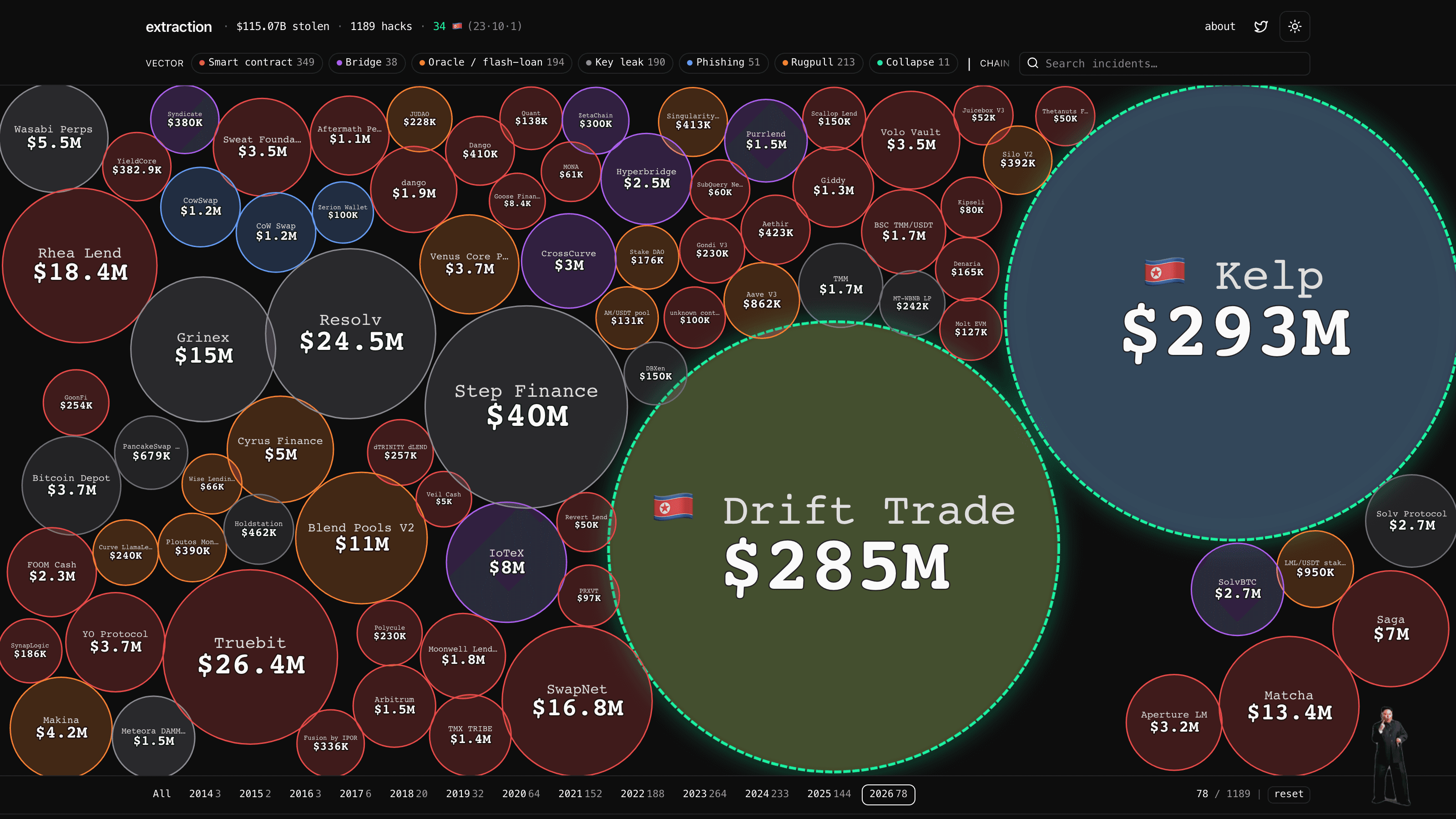
Bubbles. Each bubble is one crypto exploit, hack, or collapse — sized by USD lost, colored by attack vector. Drag-pan the canvas. Click any bubble for the incident modal. Scrub years across the bottom timeline. Filter by vector or chain. Search by name in the top-right. CSV export of all 1,189 records.
The headline numbers update from a static JSON file built at deploy time:
- 1,189 incidents since 2014
- $115 billion stolen, drained, or "lost"
- 34 attributed to Lazarus / DPRK across three confidence tiers
- 8 attack vectors with distinct colors
- 109 records with on-chain attacker addresses linked to block explorers
No backend. No database. Just JSON + ISR + a d3-force simulation rendering ~1,000 SVG circles.
Data spine: not just DefiLlama
DefiLlama runs an open Hacks API. It's the obvious starting point. Free, daily-refreshed, ~510 records. So I started there.
Then I noticed gaps. Mt. Gox 2014. Bitfinex 2016. Terra LUNA / UST May 2022. None of them in DefiLlama. They're the most-asked-about events in crypto history and the spine doesn't track them.
The fix took three layers:
Layer 1 — SlowMist Hacked scrape. SlowMist runs an HTML-only listing of every documented blockchain incident. 2,064 entries. I scraped paginated, parsed with regex, filtered to ≥$100K loss → 1,350 candidates. Fuzzy-deduplicated against the DefiLlama spine: 161 exact-id matches, 377 fuzzy matches, 114 intra-source duplicates. Net new: 666 unique incidents.
Layer 2 — Manual curation. Hand-curated JSON file of 21 incidents that neither source tracks: pre-2016 era (Mt. Gox, Bitstamp 2015, Bitfinex 2016), supply-chain attacks (Ledger Connect Kit, npm @solana/web3.js compromise, CoW Swap domain hijack), and 11 major collapses tagged as a new vector (Terra LUNA, Celsius, BlockFi, FTX customer shortfall, 3AC, Voyager, Genesis, Iron Finance, Babel, Hodlnaut, Prime Trust). Each entry has primary-source URLs from DOJ, SEC, Reuters, or Chainalysis.
Layer 3 — Tavily for credible sources. ~70% of records had no per-incident article URL. SlowMist references mostly point to Twitter posts, which 404 over time. I ran every record through Tavily search filtered to credible domains (Rekt, Coindesk, Halborn, Certik, Chainalysis, TRM Labs, Elliptic, FBI/Treasury). Result: 731 records with linked credible sources — Halborn's Poly Network postmortem, Coindesk's LuBian coverage, Chainalysis on Ronin, etc.
Lazarus tier system
The hardest signal to get right is attribution. "This was Lazarus" is a strong claim and the source matters.
I split it into three tiers:
- High (FBI / Treasury / OFAC / DOJ formal indictment) — 23 incidents
- Medium (Chainalysis / TRM / Elliptic published report, no government sanctions yet) — 10 incidents
- Rumor (community speculation, no primary source) — 1 incident
Each tier has a different bubble appearance:
- High: solid 4.5px green stroke + 2s pulse. Loud.
- Medium: 3px stroke + dashed pattern + 4s slower pulse. Quieter signal.
- Rumor: 2px dashed stroke, no pulse, dimmed. Visually says "this is unconfirmed."
So a Bybit 2025 ($1.4B, FBI-attributed) bubble pulses urgent green. A Munchables 2024 ($62M, Chainalysis-only) one pulses softer. A rumored attribution shows a stationary dashed ring.
Data-quality scars
Three bugs made the project useful in unexpected ways.
TokenStore $1B → $160M. SlowMist's 2019 entry showed a $1 billion loss for the TokenStore Chinese Ponzi. I shipped that. A reader (the user — me) noticed the Quadriga Initiative report puts the actual figure at ~$160M. The $1 billion is what the Ponzi promised in pseudo-balances, not what was extracted. I built a data/discovery-corrections.json manual override file and re-deployed.
OneCoin $440M → $4.5B. Same source, opposite bug — SlowMist tagged OneCoin as $440M. SEC and EU prosecutors estimated $4-15B over the scheme's life. Override.
PolyYeld auto-drop. SlowMist's PolyYeld Finance 2021 entry showed $4.9 trillion. That's the minted token count, not USD. The actual USD loss was probably $200K. Auto-dropped via an implausible-amount filter at $10B. Surfaces a list of dropped records for manual review.
These three corrections taught me one thing: never trust a single-source amount field. The verify-amounts cross-check script (which Tavily-extracts USD figures from credible sources for the top-100 records by amount) flagged 49 mismatches; ~80% were noise (regex picking up recovery numbers or unrelated mentions), but 5-7 were real bugs.
Fuzzy dedup is harder than it looks
The merge step takes ~2,000 candidate records (DefiLlama + manual + SlowMist) and produces a single deduplicated dataset.
First version: name similarity ≥50% word-overlap, ±1 month, ±15% amount tolerance.
It produced 262 attacker-address matches. Spot-check: 109 false positives. "Ronin Bridge" matched "BNB Bridge Exploiter" because they share bridge (50% word overlap with both stems containing one shared word).
Fix: substring-containment check first ("Wormhole" contains "Wormhole Bridge"), then word-overlap requiring at least one non-generic match — generic words like bridge, network, protocol, dao, swap, finance, markets, exchange, token are filtered out before comparison. After the change: 109 matches, almost all correct.
Generic-word stop-list:
const GENERIC_WORDS = new Set([
  'bridge', 'finance', 'protocol', 'network', 'capital', 'labs', 'lab',
  'group', 'dao', 'swap', 'market', 'markets', 'exchange', 'token', 'tokens',
  'chain', 'foundation', 'global', 'one', 'pro', 'app',
]);
Lesson: in domain-specific fuzzy matching, the noise ratio of generic shared words is what kills you, not the typos.
Things that didn't ship
- Solodit / Immunefi audit data. Both are SvelteKit SPAs with tRPC backends. Scraping them requires full Playwright browser automation. Estimated ~6 hours of fragile selectors. Deferred — would have been the last 20% of effort for the 10% of records that actually have audit history.
- Audit-firm filter chip — depends on Solodit data, deferred with it.
- Per-incident detail pages (
/incident/[slug]) — every modal-shown record could be its own SEO-friendly URL with full sources. Not in scope for v1; permalink via?incident=<id>query param ships instead.
Stack
Nothing exotic.
- Next.js 16 App Router, ISR, MDX (for /about page)
- d3-force for the bubble simulation. Custom collide tuning, adaptive max-radius per visible subset, hard bottom clamp
- Tailwind CSS 4 + Geist Sans/Mono, dark/light theme via
next-themes - Static JSON at
public/data/hacks.json, ~1MB minified, 6h ISR - Vercel for hosting + edge caching + auto-deploy from GitHub
- Cloudflare for DNS (DNS-only, no proxy — Vercel handles SSL + CDN)
- Tavily API (3 dev keys with rotation) for source enrichment
- eth-labels.com API for attacker-address enrichment (109 records)
- Google Analytics 4 + Vercel Analytics + Speed Insights
Total git history: ~50 commits across the weekend. Probably 12-14 hours of pair-coding with Claude Code, including the rebrand from crypto-exploit (working name) to Extraction and Cloudflare domain registration on Sunday afternoon.
Postscript: what vibe-coding actually looks like
"Vibe-coded with Claude Code" is shorthand for a specific working pattern:
- No PRD. I described the desired output in plain English and adjusted as I saw it render.
- Live feedback loop. Each new feature got built end-to-end (data → component → CSS → deploy) before moving to the next. No backlog accumulation.
- Claude Code as pair partner, not autocomplete. Multi-step tasks (Phase A: enrich DefiLlama fields → Phase C: repeat-exploit detection → Phase D.2: Etherscan attackers) ran as agentic subtasks while I reviewed PRs.
- Toy poodle as design lead. Strong opinions about chair-time. The donate modal in extraction.work's footer carries her likeness as the support button.
Reading the git history back, the surprising thing is how much time went into data quality rather than UI. Two-thirds of commits touched the discovery / merge / verify-amounts pipeline. The bubble simulation, modal, and search worked on the first try and barely needed iteration. Garbage-in-garbage-out is the gravity of any data project — the visual layer is the easy part.
If anything from extraction.work is useful — a citation, a memorable bubble, an "oh, that one was huge" moment — the price of a coffee covers a couple weeks of hosting and Tavily quota. Donate buttons in the footer point to BTC, ETH, SOL, and USDC wallet QRs. The toy poodle approves.